

John Healey announced in his recent budget that there would be an additional allowance for pensioners whose income was up to the level of the basic state pension but higher than the personal allowance of £12,570.
This additional personal allowance had been mooted since the increase in the basic state pension for 2027 had been confirmed to be over the level of the personal allowance. Andy Burnham had said that pensioners who purely relied on the basic state pension would not have to pay tax, but it was just the mechanism of how this would be done that was confirmed in the budget.
The allowance has actually been extended to include any income, as long as it is under the new basic state pension of £13,036.40. So, for example, if you have a state pension of £10,000 pa but a private pension of £3,000 pa then you would still get the extra allowance.
If your income is slightly higher than £13,037 then there will be some taper relief so that you will not be suddenly dropped back to £12,570 and then be worse off than if you earned less. So if your income is between £13,037 and £13,319 then you will receive some pension tax allowance.
For every £3 of income above the level of the basic state pension (i.e. £13,037 for 2027/28), your pension tax allowance will reduce by £1, so by the time you earn £13,319 you will not get any additional allowance and your personal allowance will be £12,570.
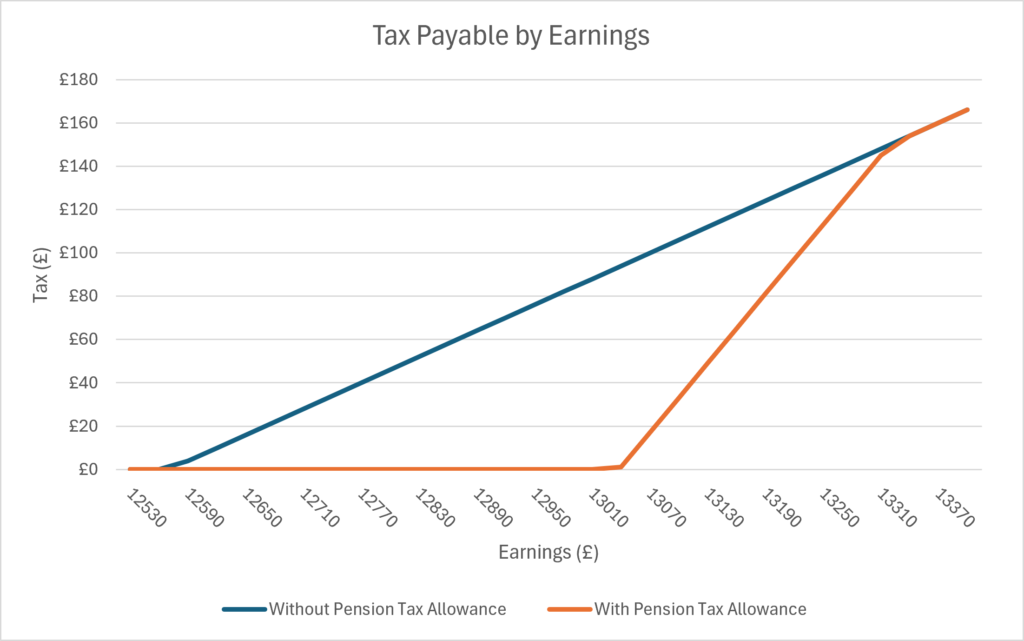
This calculation is confusing in my mind and does not match up with the way taper relief works for those earning over £100,000. In the case of the Pension Tax Allowance, the reduction only matches up to the amount of tax saved and not the actual tax allowance as I would describe it.
Although the amount of earnings that you can now have without paying tax has been increased by £467, they have not called this the pension tax allowance. Instead, they have called the PTA £94, which is the amount of tax saved (467 x 20%). So you only get taper relief if your earnings are 3 x the amount of tax saved (3 x 94 = 282 plus the £13,037 = £13,319).
Contrast this to the taper relief on earnings over £100k which reduces the personal allowance by £1 for every £2 earned over that, so when you get to £125,140 (2 x 12,570 +100,000) you lose the personal allowance.
So why is the taper relief threshold not 3 x 467 + 13,037 = £14,438? I would love an explanation to this so if you know please comment as this is an opinion piece.
The value of the pension tax allowance will increase in line with the basic state pension each year.
The fact that the pension tax allowance has been introduced does imply that the government is not planning on increasing the personal allowance at any time soon. It is currently set to remain at £12,570 until the end of the 2030/31 tax year so I think we shouldn’t expect any changes until after that date.